In my second foray into literary fiction for the year (Tori is insistent that I read more fiction) I chose a novella by a renowned Russian author known by most people for writing Lolita.Transparent Things is a brief exploration of the deep interconnectedness of things. The narrative is complicated and looping at times seems intentionally to want the reader to squint their eyes and ask themselves whether some briefly mentioned fact is in fact referencing an earlier event or character. Many times it is indeed, but just as often Nabokov is weaving a holistic metaphysics in this story in which nothing is arranged by chance, or even purely by motivation, but entirely by the comprehensive story.
Transparent Things is, in a sense, about Hugh Person’s stay in a hotel. The some hundred pages are filled out by a dive into the depth of reality offered by both Person’s person and the objects around him. The opening chapter explains it better than I can, so to quote from it,
“When we concentrate on a material object, whatever its situation, the very act of attention may lead to our involuntarily sinking into the history of that object. Novices must learn to skim over matter if they want matter to stay at the exact level of the moment. Transparent things, through which the past shines!”
This paragraph sets forward not necessarily the work’s premise, but it’s central idea, that the past and present, set apart from the future by their realness, are inextricably linked. To hold a pencil, as Hugh at one point does, involves him in a long history of graphite mixing with clay, with laborers and machines and cutting, trees, saws, blocks, and all that the pencil has written. Nabokov at times seems to play with the reader, throwing them down the rabbit hole of the infinitely-expansive past contained in a moment and then sharply tugging them into a particular later present in which participates in the past we thought we were examining in the narrative. The first several times, this results in a raised eyebrow and maybe a satisfied (or unsatisfied) sound of comprehension. This effect becomes potent and even tragic in the book’s climax, however, when a mundane moment is revealed to be the basis of something altogether more tragic.
That explained, I don’t want to give the sense that Transparent Things is a novella about time or memory in the way that The Book of Collateral Damage is. It is not. Nabokov is instead writing a novella about something which I find altogether harder to grasp for more than a tenuous moment before it fades away like a mist. Comments get worked into the prose which suggest that the act of writing is itself the pursuit of these transparencies of reality, where reality shines through by eclipsing other reality. A chapter towards the end contains a paragraph on the nature of writing a character, that they don’t seem to truly be the author’s, but instead are bound together in their fates and free choices (which are not entirely separable) with only the faintest, breathy, dream-like interference from the author possible.
Transparent Things is something of a love story, but of the sort of kind which feels particularly Russian for some reason. The love is given only some room amid all the book-editing of the main character and the past-exploring of the author. It is more like a universal tragedy. As soon as the opening pages were written, or, if you like, as soon as the characters were born, it appears as though nothing other than a very particular doom could ever have awaited these characters.
Further exploration of a novella this tightly woven is for someone more skilled in literary criticism than I am. Still, this is another book I can strongly recommend for anyone who likes thinking in free, abstract ways, fond of repeated motifs, are interested in book publishing, or who would like to enjoy a kind of tour of a small Swiss town in a hundred pages.
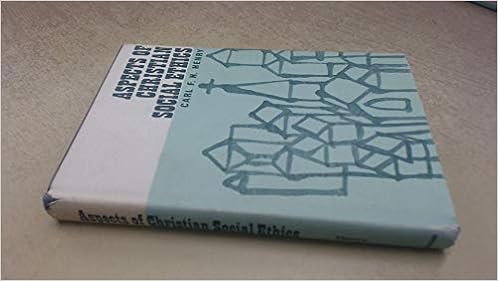
Before reading Aspects of Christian Social Ethics, I had often heard the name of Carl Henry in passing conversations. Attending the Southern Baptist Theological Seminary results in hearing names that I rarely, if ever, hear in other settings. I don’t mean the names of prominent figures of Church history that might be discussed among any group of faithful and well-read believers, like John Calvin, Augustine, or George Whitefield. I mean instead a group of people who are known by my fellows because of their particular influence on not only our particular tradition of Christianity, but even particular faculty members and notable alumni. Henry is one of the figures of the past with this sort of notoriety at my school. His writings have been influential on Russell Moore and was the topic of a book edited by Provost Matt Hall. It was for these and several other reasons that I was very interested in reading Henry’s brief collection of lectures concerning how the church ought to related to its broader cultural context.
Henry was well-suited to give these lectures and publish them. He was a professor of Philosophy and Systematic Theology and gave a great deal of time and energy to considering how Christians should apply the truths of God’s word to doctrine, thought, personal ethics, and public conduct. By the time he published this book in 1964 he was a leading figure among mid-twentieth century Evangelicalism, though he had not yet gone on to publish his magnum opus, the six-volume God, Revelation, and Authority.
Aspects of Christian Social Ethics contains five lectures edited into essays and an appendix on “Christianity and Revolution.” The opening chapter, “Christianity and Social Transformation,” attempts to delineate methods by which any group may attempt to change their society and choose among them for the church. He argues that they may be divided four ways, though admits that the division is a touch arbitrary, into Revolution, Reformation, Revaluation, and Regeneration. While evaluating and illustrating the commitments and consequences of each, he concludes that the Christian church must hope for the regeneration of society by the power of the Holy Spirit and forsake the other methods of change.
Revolution, he argues, relies on brute force to achieve a deep and fundamental change of the status quo. With the Bolshevik and Chinese Revolutions clearly on his mind, he also asserts that it has an inherently anti-theistic bent. In any regard, however, he sees its violence and autonomy as contrary to Christian teaching. Reformation, the hope of changing society by changing the social environment gradually through education and legal action, is the face of a coin shared with revaluation, the independent hope that by communication of values will cause individuals to take better actions. Both fall short of recognizing how desperate the human condition is and by asserting a power of change independent of God. Reform is especially undermined by its deep need for contact with the status quo, thus losing the ground of its own normative assertions for change.
The failure of these is not that they are always necessarily wrong, however. Rather, they fail because they lack a transencent basis for moral authority which allows critique of the status quo and also regulates their own actions. As Henry concludes, “The Christian movement has a stake–a vital stake–in education and legislation. It need not disparage every effort at reform and revaluation as abortively competitive… Yet Christianity knows–and it dare not forget nor let the world forget–that what the social order most needs is a new race of men–men equipped not simply with new textbooks and new laws, but with new hearts.”
The second essay, “The Christian View of Work,” is more connected to work as the intersection of inner personal piety and our greater social environment. Henry argues that the work of a person is not chiefly to be a way of securing their personal sustenance or for enriching their employer, but instead an act of creation. Work is thus a calling, in every individual is to use their talent to join God and serve God by serving others. He notes that the early church would add their manual labor jobs to their tombstones, an unusual behavior for their Roman context, and concludes that they did so because of their grasp of the biblical teaching of work.
He mourns alongside the average worker who feels alienated from the goodness of their work, making the connection between fallen, fruitless labor and a fallen, futile world. He then chastises Christians for indulging the same feelings, however, because of the glorious nature of their work. He admits that some innovations of modern capitalism make grasping the true nature of work difficult, specifically giving attention to the possibility that Christians ought to oppose the assembly line. Nevertheless, Christians ought to recognizes that God is well served and perhaps even human lives are saved by something as mundane as properly tightened screws.
He explores the obligations which employers and employees have to each other, that employers ought to pay well enough to enable creative, fulfilling labor and also provide a safe environment conforming to the dignity of the worker, and the worker ought to give their full effort and energy to the labor and not make demands based on coercion or deceit. He laments, “go slow,” policies and is wary of strikes, but commends a handful of labor unions actively organized on Christian principles of work. He finally concludes that a Christian must pursue excellence at their tasks. God is not a mediocre Creator, nor is a man allowed to be less than the best cook, photographer, teacher, or construction worker which he possibly could be.
The next two sections are essentially two halves of a single unit. Both bear the title, “The Christian Stake in Legislation,” with the first half dealing with, “Theoretical Considerations,” and the second dealing with, “Practical Considerations.” They both attempt to give grounding to the question of whether and how Christians should attempt to influence the laws of their country.
Quickly, he sets out that just as no form of governance can claim clear Biblical warrant, neither can almost any specific legislative proposal. This ultimately prohibits churches themselves from weighing in on matters of political significance, even if it is in pursuit of conditions in which the gospel may plausibly be more easily and freely preached. Rather, Henry envisions the church’s reaction to social ills as part of an expanded sense of evangelism. That is, he argues that the church’s main responsibility is always to proclaim the good news of Jesus, that his death and resurrection has atoned for our sins. That is not to say that such proclamation ignores injustices in the community. To the contrary, social injustice is every bit as much of the sin which must be repented from and atoned for by Christ, lest God pour out his wrath for it, as promiscuity, thieving, and murder. In this way, the Church does not establish or lend its support to specific proposals, but does zealously warn of what the Bible warns of, God’s wrath upon evil.
Christians, as distinguished from the larger church body, however, have special obligations for themselves. They owe a limited but sincere obedience to whatever state rules over them, whether they be just or tyrannical, restrained or totalitarian. They must resist laws which hinder the gospel or contradict their obedience to God, and they must seek to have full, informed opinion of their world and seek to best use whatever gifts of thought, insight, communication, or even power which God has given them to achieve righteous and good results in the world, both by reminding government of its limitations, for it is created to serve God, and in its obligations and duties for justice. He encourages Christians to resist inclinations to besmirch politicians as a class and to encourage their children to consider policy-making and politics as worthy a career as becoming a doctor or engineer, so long as it is done ethically.
In any case, Henry is insistent that the aim of believers must never be to secure sectarian benefits for themselves. Neither are Christians permitted to attempt to force through in law for all what is required of them. Such claims of power for the state are beyond what is appropriate for it. Rather, Christians ought to see to it that the activity of the state is concerned to the utmost with justice, the maintenance of order through equity in public life, so that the state regards all equally and gives to each their due. He is critical of those who claim, for instance, that civil rights was an issue of love and the gospel. For Henry, such a claim undermines not only the special focus of the gospel, but also the demands of the state. The love of the gospel is elective, given to its recipients despite their deep undeserving. In contrast, the state must be utterly impartial, and thus is the true and right basis of legislation like the Civil Rights Act, etc.
The last of the full chapters is an attempt to flesh out the distinction of justice and love in a section titled, “The Nature of God and Social Ideals,” in which Henry criticizes Protestant Liberalism’s frequent insistence on shaping public policy in terms of Christian love. This he says is a mistake which flows from an error of theology first and foremost because it is grounded in an assumption that love is the foremost of God’s attributes so that it relativizes all other of God’s attributes and actions. He documents this position thoroughly before asserting that this is an innovation, and that the Bible and church history have seen Righteousness and Love as coequal in God’s nature. God is sovereign justice no less than God is sovereign love. The result is that Henry imagines a scheme in which the government, tasked with the preservation of society and the restraint of evil, is tasked with a duty toward justice so that all receive what they deserve, where it is the Church, the new humanity created by Christ without any deserving on their part, which is free to dispense love freely. Law is benevolent, but it is distinct from benevolence itself just as justice is distinct from grace.
The book concludes with a brief ten pages devoted to taking an overview of the question of revolution in specific contexts of unjust and tyrannical rulers. Here, Henry asserts much less, and I got the feeling while reading it that this was because he had not yet made up his mind on some key questions. Nevertheless, several useful principles are established: Christians ought not to permit political murder, but instead seek whole unjust systems to be overthrown so that justice may truly spring forth. It is generally wrong to attempt to undermine civil authorities, and to do so must be on exceptional grounds. It is wrong for Christians to attempt to pursue revolution on the grounds of a state’s brutality toward themselves, but in such a case ought to pursue the proclamation of the gospel and accept persecution and even martyrdom glady.
Aspects of Christian Social Ethics is a book that, though I suspect is not widely available to most people, I wish many Christians would read. It is a valuable corrective to wrong ideas that arise from living in this particular cultural moment, and I found many of my own ideas being challenged and in several instances my mind changed entirely. To be a relatively old book, it is well written and easy to get through. It contains a great deal of wisdom and humility on the part of its author, which permits the depth of his confidence in the authority of Scripture to stand with inspirational clarity.
Translated from the Arabic by Jonathan Wright. 303 Pages. Begun 05/10/2019. Finished 05/12/2019
It has been a long time since I read a literary novel. Unless I forget something Tori has gotten me to read, this is the first since my senior AP English Literature class in highschool. I always enjoyed literary novels as a child and teenager, despite my first extended times of reading being spent on science fiction. Somewhere very early into college, though, my reading habits became focused on nonfiction and genre fiction, as my prior entries on this site demonstrate. Tori and I went to a bookstore at the start of this weekend, however, with the intention of buying two books each. It was part of our way of continuing to celebrate our anniversary, which is today. We read the rest of the evening and through yesterday together. I chose to buy this book for a number of reasons. It felt right that I should read a literary novel on our anniversary, because Tori dances in the world of beautiful prose written about things that somehow transform mundane things into art. It also has a beautiful dust cover, which immediately caught my eye because of my years of painfully trying to learn Arabic. The fact that it was a novel by an Iraqi author originally written in Arabic and translated also piqued my interest.
I bother to include this prelude not just because I want the world to know that it’s our anniversary today. The Book of Collateral Damage is a novel about moments, articulated instances where memory gives shape to something very real and tangible. This gives the book its form and the ground of its philosophical explorations. The moments that the book are chiefly concerned with are those of tragedy and formation.
Nameer, the book’s protagonist, is an Iraqi-born immigrant to the United States who, after his PhD work at Harvard, begins his academic career in Arabic Literature in 2003 in the wake of the beginning of the Iraq War. During a brief return to assist a documentary of the war consequences with translation, he meets an eccentric bookseller who is attempting to write an index of all of the casualties of the first minute of the Iraq War, an expansive project that mingles robust research with imagination. The two become friends and begin communicating.
At the intersection of Wadood’s mournful writing project and the American unease surrounding the Iraq War, is Nameer’s restless melancholy, which pushes him to explore New York City as he finds himself increasingly drawn into his own memories, even as he becomes obsessed with Wadood’s own project of reconnecting the world to its past. Nameer’s narration of his own day-to-day life becomes interspersed and mingled with entries from Wadood’s index, memories from his own past, their letters back and forth, and selected quotations about time, memory, and our relation to the past from Walter Benjamin.
What results is an opportunity to feel the horror of war, not from the perspective of the frantic soldier or the horrified civilian, but instead from the perspective of the memories which are forced into their resolution by an unknown terror. Ancient tablets, prison-made rugs, pianists, and birds all have their moments and memories resurrected at the same time that Nameer is finding his own memories of an estranged father, more distant past life in Iraq, school-aged exploits, and former lovers all asserting themselves on his day-to-day experience. The reader is free to see two men attempt, with incredibly varying degrees of success, to make sense of their own past and incorporate the men they’ve become as a result into their present realities in order to keep walking forward.
The poetry of Wright’s translation of Antoon’s ideas are at times breathtaking, and I was regularly moved to real sadness at Antoon’s way of crafting the abrupt endings of shattered lives. The ending is a remarkable and clever crystallization of what had come before that left me smiling but very sad. There are occasional moments when the past scenes become crude, but these are brief and only serve as articulations of the curiosities and confusions that guide us as we moved from our past selves into being who we are today.
One potential weakness of the book is its dialog. For the first two thirds of the book, nothing ever broke my immersion. Later, however, when Nameer begins having long conversations with non-Arabs, my eyes kept stumbling. I realized that the dialog written between Nameer and others from Iraq sounded like the English spoken to me by my Arab friends in general and my Iraqi acquaintances more specifically. There’s a brevity and forcefulness in grammatical construction, mingled with what sounds to my American ears like intentional ambiguity, which feels natural when spoken by Arabs that feels less natural when put in the lips of a Black woman raised in New York or a white man from Chicago. It took me some dozen pages to decide how big of a problem the dialog was before I decided that it was no problem at all. The narration is written in Nameer’s voice, and so too is the dialog that he reports to the reader. With this idea in mind, that these were his reports of what was being said, I coasted through and deeply enjoyed Nammer’s interactions with others as they guided him towards coping with his depression.
I would suggest that anyone interested in memory, time, Arab culture, language, the Iraq War, PTSD, or the pressures of an academic career read this novel. I found it so delightful that I now plan to return to literary novels a few times this summer. I haven’t very often read 300 pages in less than 48 hours, but the gravitas of Antoon’s prose and arrangement will pull you in for a ride. The book was published just this month, and while I write this, it appears there aren’t many reviews online yet, so you’ll have to take my word for it.


 Logan & Tori Read