By Logan
Begun 02/02/2019 Finished 03/03/2019
111 Pages
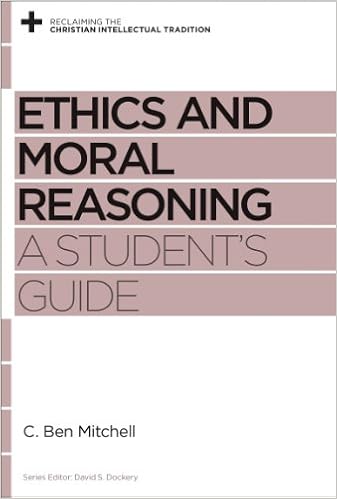
I’m glad to get to finally add one of my books for class to this blog and my list of books for the year. Reading books for class is an odd occupation when in pursuit of a goal like what Tori and I are attempting here. The method of class reading, in which sections of a book are read slowly across a month or two, does not translate well to the pattern of books implied by attempting to read a book and then write a reflection or review on it. C. Ben Mitchell’s Ethics and Moral Reasoning did not get the attention it deserved from me, as a result. None of the other books which are added because of my coursework at SBTS will, either.
That said, Mitchell’s short summary of Christian ethics is an enjoyable read and likely would prove very useful for anyone attempting to take their first dives into the field of ethics, Christian or otherwise. This is precisely its goal as an entry in the Reclaiming the Christian Intellectual Tradition series, which seeks to introduce Christian students and teachers with the philosophical ideas which have been related to Christian thought across its long history.
Ethics and Moral Reasoning begins by establishing the need for it with an attack on, “relativism,” Mitchell’s label for the sense in modernity that trying to actually determine what is good and bad is a waste of time and that instead we should think of morality in terms of, “right for you,” and, “wrong for me.” After examining the logical bases for this way of thinking about ethics, Mitchell dives into the task of elucidating the broadest contours of a distinctly Christian ethics. He does this by first showing the relationship between the ethical statements of the Old and New Testament and the ethical thought of the broader Ancient and Medieval world. He proceeds on a brisk tour of modern Western philosophy, surveying the ethical thought of Kant and Bentham and Mill before noting favorably the arguments of Virtue ethicists in recent decades against them. Finally, he overviews the best of Evangelical ethicists of the past century before setting up general guidelines for those who themselves do the work of discovering right and wrong in the world.
Mitchell’s work is an excellent, though perhaps too brief, introduction to ethical philosophy and theology for those unacquainted with these ideas. It also serves as a handy list of names who should be read and wrestled with if one wants to engage seriously with what it means to live as a follower of Christ in a world with ethical decisions to make. I found the penultimate chapter by far the most enjoyable, no doubt because it was the chapter with the most content that was new for me, personally. Getting succinct summaries and a few excerpts of the great thinkers like John Murray, Carl F. Henry, Arthur F. Holmes, the now virtually preeminent Stanley Hauerwas, Oliver O’Donovan, and Gilbert Meilaender was fascinating and novel.
This book is at times too compact and risks oversimplification of the ideas that it presents, but for Christians looking for a quick way to get into ethical thought, especially those who are young, it’s definitely the right tool for that job.
 Logan & Tori Read