The Fifth Season by N.K Jemisin

By Logan

468 pages
Begun 06/21/19; Finished 06/24/19
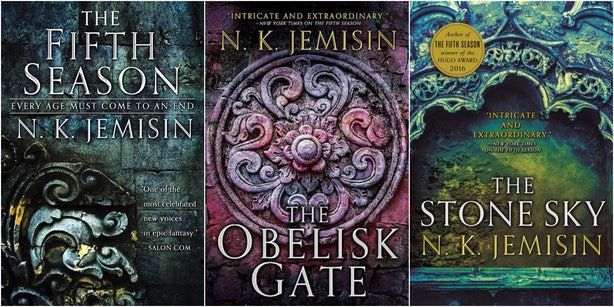
Image result for broken earth trilogy reddit

Over a week’s vacation at the beach I read the fantasy trilogy that Tori purchased on our anniversary, which she reviewed here. Instead of writing a blog post about the trilogy as a whole, I want to write a post about each of the books. This is partially because I would like to write about the second and third books without concern regarding spoilers, partially because I want to reflect on each book individually as well as with regard to its place in Jemisin’s overall story, and partially because I use the individual blog posts to actually count how many books I’ve read this year, (not counting some things for classes) which Tori uses Goodreads to do.

The Broken Earth Trilogy is a fantasy series with several bold decisions. It is a genuinely post-apocalyptic entry into the fantasy genre, a choice which I think has inherent risks but gives considerable payoffs here. Jemisin writes one of the perspective characters from a second-person point of view, a move that helps the audience relate to a character who is not the usual fantasy novel protagonist, and also permits a fair bit of distinctive, clever prose. That identification and relation is significant also because of another bold choice Jemisin makes; that is, her chief protagonist is a middle-aged woman of color with two children and a lot of trauma. While most characters in this world are not caucasian, the world is so far removed from our own that patterns of oppression and subjugation flow in ways related to its magic system, but the connection should not be missed.

This is a book series with a lot of hurt people trying their best to make it through very difficult situations alive. For that reason, it is a series that explores pain, shame, and suffering. This is a series of rage. If seeing the raw anger and brutality of the oppressed makes you so uncomfortable that your ability to relate to people in hard positions, this is not a series for you. Otherwise, I hope you dive in.
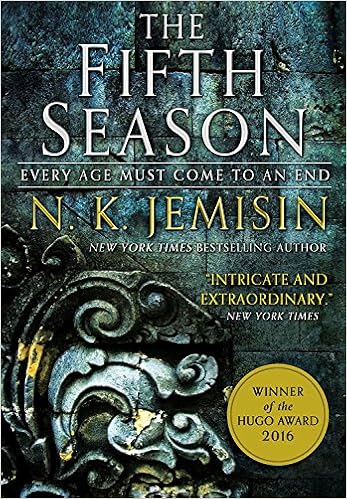
Image result for the fifth season

The Stone Sky is Jemisin’s lead-in into the Broken Earth. It follows three women of different ages, all of whom are connected to Orogeny, the magic of Jemisin’s world. Essun, the aforementioned middle-aged mother, flees her home on a hunt to try to find her husband and daughter in the shadow of a continental-scale catastrophe after years of hiding her magical abilities in order to live among normal people. Syenite is a professional orogene, controlled by a centralized authority designed to utilize the benefits of the powers orogenes possess while also keeping the population from brutally killing them all in bigotted protest. Damaya is a young child entering the control of the same organization, displaying the disturbing mix of loyalty and cruelty it shows those in its care.

These three characters give insights into not only the excellently built world Jemisin has constructed, but also into the dynamics of oppression and subjugation. Orogenes, called “roggas,” by those who are unsophisticated enough to use an impolite term, are systematically excluded from the broader humanity because of a mixture of fear and irrational hatred. Those that are hiding among others are killed by mob. Those who enter the control of the Fulcrum have every aspect of their lives dictated to them by its power structures, where they go, what they do, how they behave, and even who they have children with (Sexuality is a topic given significant attention in this book. Scenes made me blush, but are rarely crass, though for sure this is not a book I’d want in the hands of a child or most teenagers.).

All of this takes place as the world ends. The first pages show that despite humanity’s attempt to survive the endless, chaotic patterns of destruction arising from turbulent, dangerous underground activity, they are not prepared to survive this last disaster thrust upon them. This fact recontextualizes all of the dangers and cruelty and desperation and fury into something deeply poignant.

The characters in this book will stay with you. Alabaster, an orogene of unprecedented skill and ability, never stops giving wry, tortured commentary on the absurdity of the world around him. Crack, a peer of Damaya, reveals with alarm the depths of the damage people do to each other, how that warps their conduct, and also how that kind of hurt is always bound up in greater, darker systems of injustice. Hoa, a young child Essun meets along the way is nothing at all short of a spectacle and oddity in and of himself.

Jemisin’s work in the Fifth Season is one of reflection, catharsis, but most of all unflinching examination of what it means to be human when the world around us is wrong.
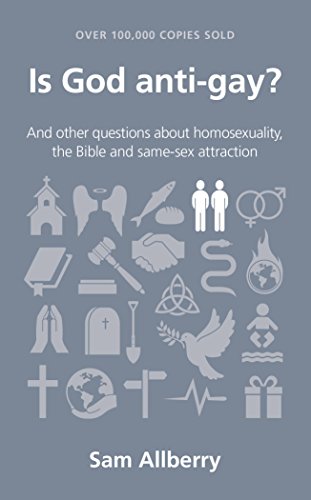
Is God Anti-Gay? by Sam Allberry

By Logan

Begun 06/06/2019, Finished 06/07/2019
83 pages

Image result for Is god anti-gay?

The Questions Christians Ask book series is a series of short, simple, helpful books for providing clear and orthodox answers to questions that Christians and others have regarding their faith. It includes other entries like, What makes us human?, Why did Jesus have to die?, Where was God when that happened?, and Is hell for real?, among many others. Sam Allberry’s contribution to this series is a matter of special significance and expertise to him. While going through scripture to attest to the Church’s historic position on sexuality, he weaves in his personal experiences as a pastor and same-sex attracted man in a way that informs his entire public ministry. With many close friends who identify as gay, lesbian, or otherwise, his insistence on practicing humility and asserting the human, God-created dignity of these friends is all that’s needed to see why he has been the most significant thinker on this issue among evangelicals for years.

True to form, Allberry begins Is God anti-gay? on the surest possible footing: exploring what the Bible says not about homosexuality, but instead human sexuality. By locating the doctrines regarding same-sex attraction, acts, and relationships inside the larger docrines of sexuality, humanity’s special creation by God, and Creation in general, Allberry roots his book into streams which are capable of helping Christians give life to those in need, not only rebuke or harsh words, as less careful and pastoral figures have done who have taken up this topic.

This work done, Allberry devotes his four remaining chapters to four key assertions:

  1. The Bible is unambiguous that sexuality is reserved for monogamous marriage between man and women.
  2. That there are good ways for Christians who experience same-sex attractions to live out their lives in dignity, satisfaction, and full obedience to God.
  3. The church must work diligently to support those who struggle because of their sexual attractions, comfort those who face unjust brutality because of their attractions, and stop putting special priority on homosexual attractions and desires such that they outpace the work of the church.
  4. That Christian individuals ought to work hard to let their unbelieving friends who are gay, lesbian, bi-sexual, or otherwise know that they love them and are for them while also speaking prophetically into the world to call all to the gospel of Christ.

All four are argued on the basis of the Bible and the human dignity that is revealed within its pages. I won’t retrace each of the arguments here, but I will say that I find Allberry’s work on each of these points entirely remarkable for the significant space constraints he is operating with.

Allberry’s eyes never drift far from the gospel that Christ came into the world to bear the weight of our sin, disorder, and death on himself so that those who turn to him might live free of these things. As a result, he speaks with a mutually reinforcing clarity and optimism. For Christians struggling to make sense of what God says regarding human sexuality, or unsure of how they ought to love their neighbors in this sense, or deeply bothered by the failure of their local church to love those affected by this issue, this is a crucial and worthy starting point.

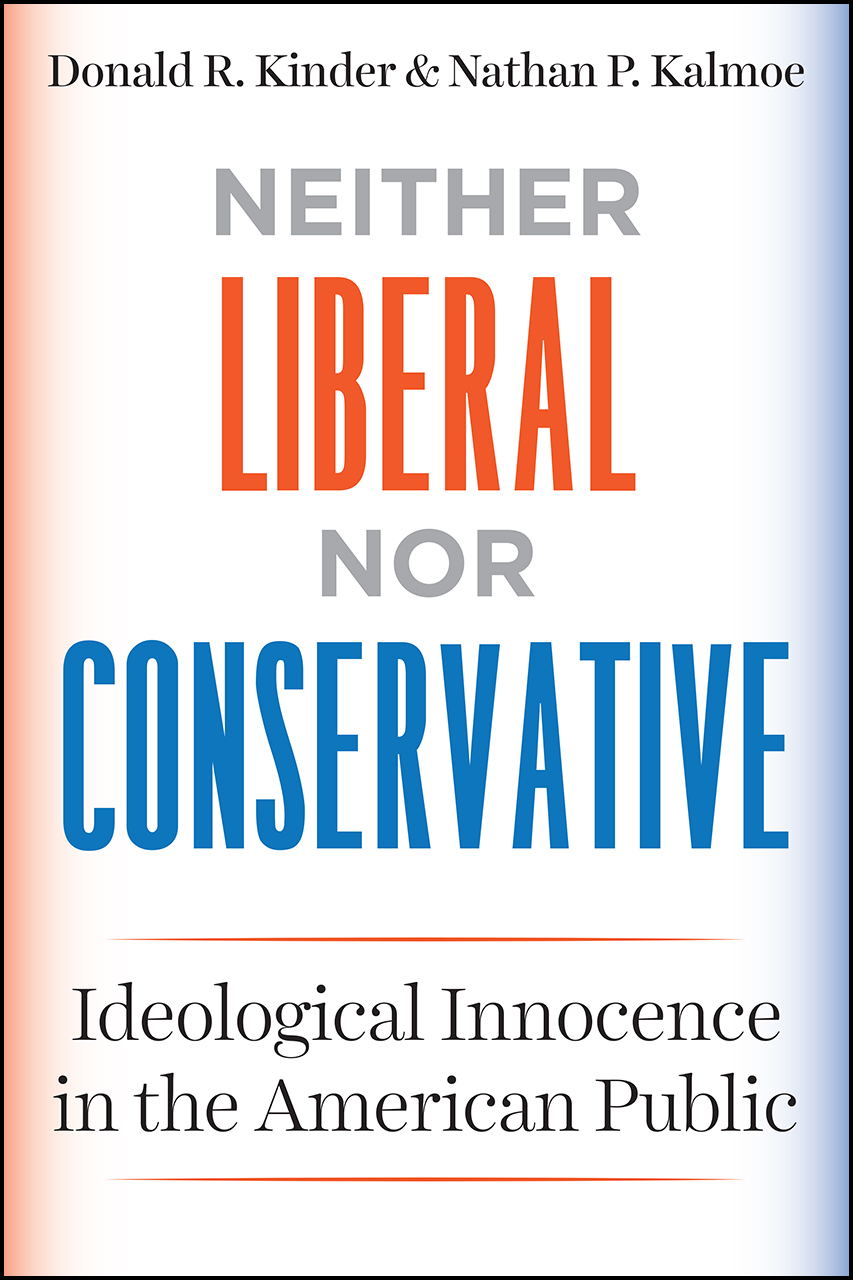
Neither Liberal nor Conservative: Ideological Innocence in the American Public by Donald R. Kinder & Nathan P. Kalmoe

By Logan

213 pages
Started 7/02/2019; Finished 07/07/2019

Image result for neither conservative nor liberal

A lot of ink gets spilled on ideology. Articles show that Congress has divided itself into patterns of ideological gridlock so tightly that it can’t achieve most popular policies. Pundits proclaim that radical liberals or conservative extremists are dangerous and out to destroy what makes the country great. Internet threads invite their members to look down on all of the masses of ignorants brainwashed by whichever ideology they find most distasteful. But what if the masses didn’t have an ideology at all?

This book has a simple argument, which it efficiently and tightly devotes its relatively short length to arguing: The overwhelming majority of people in America (and most democracies) have no strong ideological allegiance. While this may seem counterintuitive, I found their evidence compelling, and perhaps even overwhelming.

Using a number of clever analyses of data about American citizens, Kinder and Kalmoe uncover the reality that somewhere between 80% and 95% of the public lack the features of ideology in their thinking. Ideology is a cognitive organization of beliefs so that instead of viewing the world piecemeal, individual issues become part of a larger, more significant whole. As a result, views of ideologues on issues are linked together by this mental organization, are relatively stable over time unless their ideology changes. In other words, ideologues are consistent and stable in their beliefs.

The book’s first chapter shows that this describes a very small number of people. The rest of the book shows why that would be while simultaneously defending the claim against alternative explanations of the data. Over the course of the book, the authors note that ideology is a complex mental task that requires strong motivation and access to a lot of information. In fact, ideologues of all varieties, whether liberal, conservative, libertarian, or socialist, are almost always considerably more informed about politics and current affairs than their non-ideological counterparts. KInder and Kalmoe note that this explains why so many assume that everyone is ideological: the individuals who devote themselves to politics and the news are the individuals we see and hear about, and so their ideological stances take on a higher profile than is warranted by how common ideology actually is.

In the process of analyzing a huge amount of data, Kinder and Kalmoe discover another explanation for the appearance of ideology: partisanship. While noting that ideological preference is a weak predictor of who a person will vote for in a Presidential election, party identification is a very strong predictor. In other words, for as long as we have been keeping data on the subject (since about the 1960s) we have seen that liberal Republicans will vote for conservative Republicans before they will vote for a liberal Democrat that shares more in common with them on policy proposals. The same is true of conservative Democrats.

When you take into account the vast majority of people who have no ideology to speak of, political parties take on an even more dominant role in their political thinking. Without having strong personal insights into politics and current affairs themselves, most people rely on the real organizations that they have aligned themselves with, often donate money to, and which have real presence in their communities via local party chapters and campaigns. In other words, parties are real and personal, while ideologies are abstract sets of words. Parties determine how people vote far more than ideological identification. It also determines their affections: Republicans dislike Democrat public figures (and vice-versa) far more intensely and consistently than people who can be categorized as conservatives dislike liberals (and vice-versa).

In fact, the data in the book suggest that when people in America say that they are conservative or liberal they actually are using that word to reflect their partisanship on the basis that the high-profile members of that party use ideological words when talking about public affairs, even if they themselves don’t have a strong grasp on what those figures mean in those moments.

This sets up the duo’s conclusion, that because ideology is fundamentally a fruitless measure of public electoral behavior, the entire political science community should shift to other analytical categories. They suggest group identification as the most important factor in electoral behavior, arguing that, like political party, identifications with a religion, race, ethnicity, or profession are the sort of concrete, solid proxies which individuals without ideology are likely to use as proxies for their decision making.

This book was illuminating for me. I think I often have associated the word, “idealogue,” with categories of simplistic views of the world, ignorance, and animosity. This was on a gut instinct which said any kind of one-dimensional view of the world had to be ignoring huge swaths of nuance. I believe this is still often true, but I must also concede that the project of an ideology requires a larger inner, intellectual infrastructure than our public discussions often want to give it credit for.

This does fit with an observation I had quietly ignored for the past several years: most of the best informed people I knew appear to be the most ideological in their understandings of that same knowledge. This fact especially imprinted on me when I was young because most of the well-informed adults I knew when I was  young were very conservative. With a lifelong curiosity about politics and government and the news, I also tended to be conservative as a result. Ideology was never my highest commitment, however, and while I suspect that the ways my views on policy adapt to my religious beliefs might imitate aspects of ideological thinking, it is not, strictly speaking, an ideology.

This is a heavy social science book. If you are very curious about the claim it contains, check it out. Kinder and Kalmoe are very thorough in documenting their approach to interpreting data to arrive at their conclusions. If you’re comfortable accepting the book’s claim on the grounds that it is verified by experts using sound data-analysis approaches, feel free to pass.