By Logan
Begun 03/03/2019, Finished 03/20/2019
6 Hours 43 Minutes
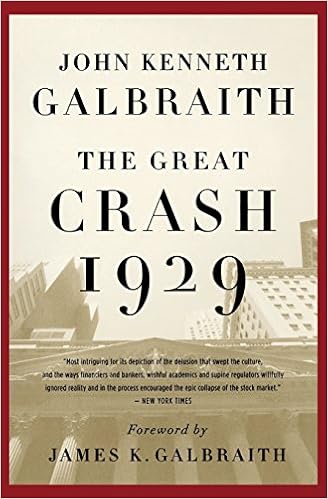
When I started The Great Crash, 1929 there were a number of things that I did not yet grasp. First, I did not realize how prominent of a scholar the author had been. I didn’t realize this even after reading the book. I only noticed several days later when, by chance, a notable current-day economist referenced him. A Google search later revealed that John K. Galbraith was a long-time Harvard professor and significant figure in 20th Century economics. In a way, I’m glad I didn’t know this beforehand because it might have ruined a charm of the book for me, for reasons I’ll explain later. Galbraith wrote over a thousand publications in his career, with many books on economics and economic theory.
I also didn’t have the strongest grasp on the timeline of the Great Depression. I had an especially hard time recognizing the series of events that led from the Roaring Twenties into the Great Depression. I knew the details well enough to have passed muster in front of my prior teachers and professors: that a way of buying stocks more cheaply, “on margin,” around the end of the 1920s caused a very serious stock market collapse that, because most people were heavily involved in it, managed to drag the whole economy down somehow into a decade of bad times. Other than that, I couldn’t have told you much. I only later would see how grossly oversimplified my understanding had become.
Like any good public scholar, Galbraith begins his detailed look into the nature of how speculation, regulatory apathy, and the indefatigable rush of believing in, “good times,” led to the stock market crash which preceded the Great Depression with a case study. He looks to Florida, where in 1927 and 28 there was a land speculation bubble which encapsulates a few essential aspects of what speculation and its inevitable child, collapse, look like.
In Florida, a prolonged period of increases in the price of land occurred. People began to buy even land which was entirely useless for any commercial activity on the basis that they believed it would continue to increase in price. To reduce the burdens of ownership to make speculation more profitable, new ways of owning land were devised in Florida. One prominent one was buying the right and obligation to buy land at a certain price. The end result was a massive inflation in the price of Florida land, which early in 1928 readjusted to reasonable levels, resulting in hard times for many people connected to the market, hard times which paralleled what was to come for the entire country. This example also draws attention to an important fact: in bubbles of speculation, the actual pragmatic value of the commodity being speculated on is entirely unrelated to its price in the market. For the speculator, the only determiner of price is the likelihood of the commodity in question increasing in price while in his hands. The radical separation of the price of a commodity from its actual productive value is a key feature of all crashes.
The Great Crash, 1929 gives a lot of attention to a lot of details of the circumstances of the crash prior to the Great Depression. While reading it, I felt deeply frustrated with the reticence of the Board of Governors of the Federal Reserve, who likely had the necessary information to caution speculators, but caved to the pressure from many different sources not to disturb the good times of increasing prices and resulting wealth.
A member of the Hoover administration is quoted as saying that they found it plausible that the country was well on its way to eliminating poverty altogether shortly before the crash. This optimism is a central part of the Galbraith’s diagnosis of where the crash originated. Run away speculation builds a pretended wealth on the guarantee that times will continue to be good and the commodity being speculated on will continue to increase in price indefinitely. Galbraith quotes a commentator at the time who thought that the increase in stock prices would also increase indefinitely. It was the assumption of continued good times which enables men to make increasingly foolish decisions with the goal of their implausibly continued prosperity.
Galbraith finds this kind of optimism to be the exact thing which is required to create a speculation bubble and subsequent crash. He speaks critically of those who assert that speculation must run rampant whenever there is easily accessible credit. He in fact points to numerous counter examples of times when credit was cheaper than in 1928-29 without causing a massive ramp in the market. Galbraith assesses that the key ingredients, rather than credit, are plausibly good times and forgetfulness. He notes dryly that every major crash, and the American economy has had several, occurs far enough apart for the people involved to have forgotten the lessons of the one prior. That speculation is dangerous and that regulation is needed to curtail its consequences is apparently an easily forgotten lesson.
A feature of the crash which began to stun me was the complete and utter lack or regulatory infrastructure which existed to prevent it. Not only were the watchers on the wall lacking in the courage necessary to make a warning which could undo the illusion of endless prosperity before there was a great deal of harm, but the Hoover administration was also loathe to intervene. This was not, as might be expected, out of pure fondness for free markets, per se. Hoover had no particular love for speculation. Rather, Hoover held certain disdain for speculators and preferred to see them come to their own ends, whatever that may be. That Hoover imagined the economy would be unaffected and that he held a desire to not involve the government too deeply in affairs of the common people were largely incidental. Other vehicles by which the crash could have been avoided were idle on more purely laissez-faire grounds.
The lack of regulation combined with the feelings of good times to produce a staggering number of economic inventions. The most interesting of these was surely the stock company. These firms had no business other than to buy stock and sell stock of their own to consumers. These were marketed as a means by which regular consumers could get into the stock market game without having to devote a great deal of time and resources to knowing how the market worked. Instead of buying stocks themselves, they could buy the company which bought the stock. These companies at various points in the late 20s were springing up by the day. These often had dubious claims to solvency, but because of the lack of oversight of them, this trouble was usually discovered only after the Great Crash.
Debt is another feature of great and recurring significance throughout the book. Debt played a number of roles in producing the long bull market prior to the crash, causing the crash to happen, and in causing the effects of the crash to be felt throughout the economy. Speculators used debt as a means of lessening the burdens of ownership of the commodity in which they were interested. By securing loans from their broker for up to 90% of the cost of their stock purchase, investors were able to purchase a great deal more of stock than they could reasonably afford. Only the stock itself was required for collateral, so long as its value remained above the loan amount. When the stock inevitably doubled or tripled in value, it could all be sold, except for the smaller amount of stock at much greater price required to serve as collateral for the loan. Then, ten times or more of stock could be purchased on a new marginal loan. In this way, virtually everyone involved in the stock market became heavily indebted, or leveraged. This constant buying resulted in rapidly increasing prices of stocks, and thus a creation of a lot of money for those who participated in the market.
Until it took all of the money back. Debt not only enabled the unprecedented rise of the stock market; afterward, it made the inevitable crash much, much worse. Galbraith records the chilling process step by step until the massive inevitability and danger becomes finally apparent. After some arbitrary and random, but small and otherwise harmless and probably short-term, downturn happened, the prices of a large number of stocks no longer were of sufficient value to serve as collateral for a margin loan. This resulted in broker calls to clients, saying they needed other collateral or to pay off the difference in the balance immediately. Worried clients sold off other stock to make up the difference. Mass sell-offs of commonly held stock resulted in further decreases in prices, which resulted in more calls, which resulted in more sell-offs. Over the course of a few months, this process occurred some eight times, each time eventually being stopped by a closing of the markets, or some other initiative.
Finally, debt made the consequences of the crash resound throughout the economy. Despite Hoover’s assurances that the essential principles of the economy were sound, there were already signs of a troubling slowdown in consumer purchasing. This was masked in its impact upon wages and employment only by the increase in the purchase of luxury goods at great expense, such as cars and boats, by the investor class. However, these investors had just lost a lot of money. Many of them lost their principle incomes. This combined with large firms who normally sold consumer goods having also invested in the market and taking severe losses to result in substantial layoffs and price-decreases throughout the country.
This is now the second book I have read which links large debt to great catastrophes in American life. The first was Edward Baptist’s The Half Has Never Been Told. It spoke of a great economic crash caused by a slaveholding public optimistic that the prices of slaves, cotton, and land were only ever bound to increase. Because slavery-based farming was eternally thirsty for more capital, this optimism led to increasingly convoluted packages of markets of debt and interconnectedness which, when the price of cotton inevitably fell, nearly shut down the entire American and British economies in the 1850s. The lack of regulation by any state or the federal government in the creation of new debt, the short term economic good times thus created, and the brutality of the result of those times ending were all brought to my mind when I read this book.
For the second time, parallels to 2008 present themselves. Indeed, since so little has changed about our economic situation (the dreadful science of economic engineering continues unabated, the stock market continues to play a very important part of many people’s lives, and seemingly everyone is in great debt) that it feels as though I am reading something specifically meant to warn our current moment. Debt and deregulation seem to be ever at the fault of the country’s economic woes. I do not think it is insignificant that those economic problems, always caused by debt and libertine approaches to wealth, are also always associated with some evil. Slavery speaks for itself. Reinhold Neibuhr, a theologian concurrent with the Depression, wrote prior to it about the injustices being created to prop up the increasingly lavish lifestyles of the Roarin’ 20s. (Interestingly, Martin Luther, the great Protestant Reformer, wrote more than once that speculation itself was inherently unjust act because it necessarily involved buying something at less than you believed it was worth and thus making a decision with apathy, even disdain, for the good of your neighbor.) The crisis in 2008 was caused by predatory loans made to the unwitting poor. It seems that whenever moral punishment is due to a society, debt and more freedom are easy ways to ensure that the punishment comes in due time and stings deeply until the lesson is forgotten. This trend, which I have discovered unwittingly, having not sought it out, is enough to discourage me from any real debt, even had I not grown up listening to Dave Ramsey on the car radio.
That is not to say that all trust in greater powers is good. In fact, Galbraith also traces the tendency across these years for people to trust that, “they,” were in charge of the whole process. Who, “they,” were is unclear to the reader because it is unclear to those who trusted it. It was assumed, when prices were rising, that some mixture of the government, the banks, and the great titans of industry, were all collaborating to see the market rise substantially for some interest or other of their own. Thus, it was the little man’s best odds to trust that, “they,” would keep increasing the market and get in on it himself. Likewise, when the market crashes happened, newspapers regularly spoke of expecting, “organized support,” for the market which would come from, “them.” This support, of course, never materialized. Despite a few clever interventions, the market did inevitably collapse. It had to collapse. The market’s rise was not based on the increasing value of the companies, but in the belief only that owning the stock itself would become more desirable based on eternally increasing prices. Had, “they,” existed as a single body of influence in the first place, “they,” would have been ultimately powerless to make any real difference. The lesson seems to demand to be learned: even the most powerful interests of the most powerful people is insufficient to countermand reality.
I enjoyed reading Galbraith’s account of this era of American history. It is, of course, a very narrow slice of that history, ignoring virtually every aspect of not only the broader culture but also the economy which did not directly contribute to the Great Crash. In exchange for this narrowness of scope, the reader receives an excellent depth of understanding and material. I feel as if I not only understand a previously murky event much more clearly, but I also have paradigms with which to understand economic occurrences in American history much more readily. If either interest you at all, I strongly suggest you pick up a copy (or rent the audiobook from your local library, as I had the pleasure to do.)
 Logan & Tori Read