By Logan
285 Pages; 76,830
Begun 01/08/2018. Finished 01/14/2018.
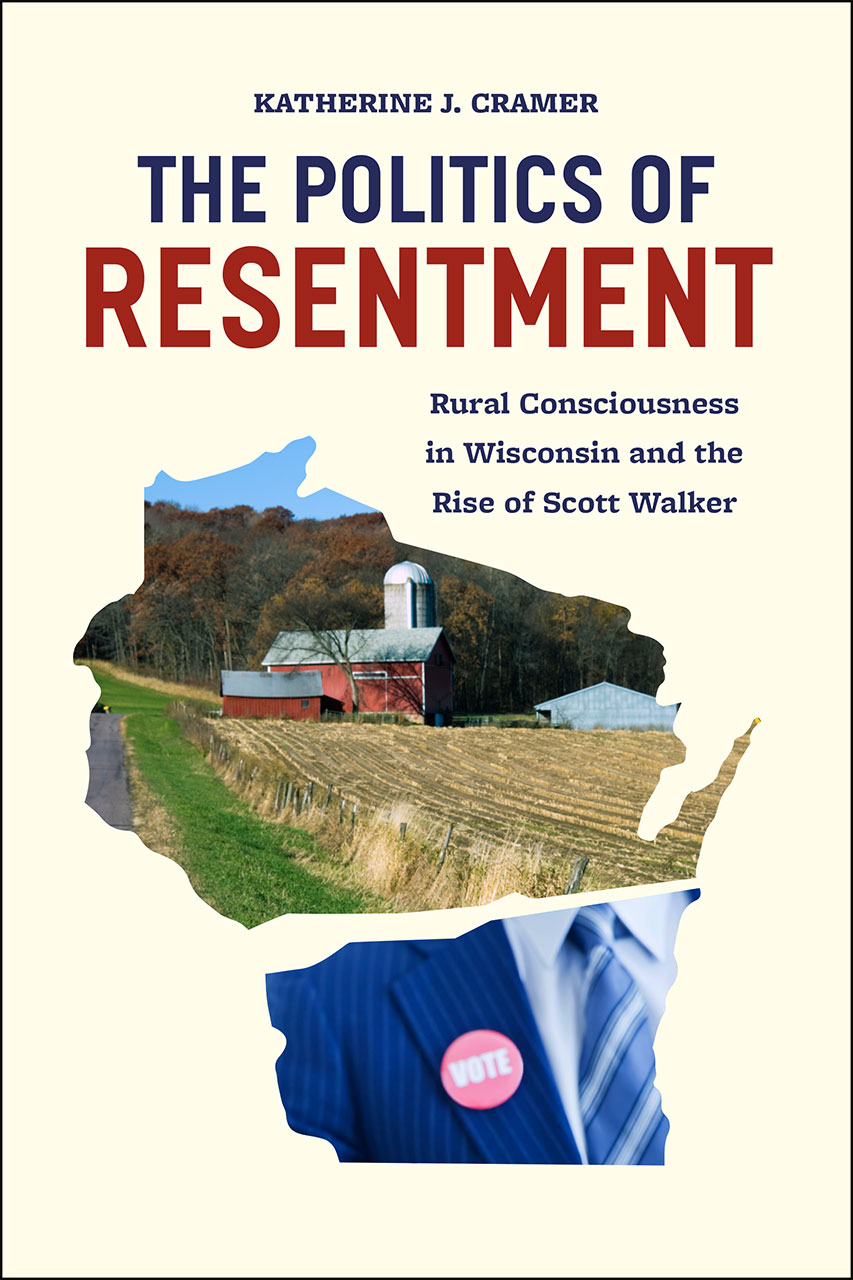
Katherine Cramer’s The Politics of Resentment is her write-up of a years-spanning study of how place, social class, and political opinions intersect. That intersection happens at “rural consciousness,” her term for a specific frame for understanding power and politics through a lens of the rural-urban divide. She identifies as having a few components:
- An understanding of rural people and urban people as very different in terms of values, knowledge, etc.
- A belief that rural areas are routinely and systematically denied their fair share of resources and influence, and thus are very disadvantaged and even dying.
- A frustration that urban powers regularly and routinely don’t listen to people in rural communities.
- A belief that urban people do not work hard in the ways that rural people do.
- Anticipation that urbanites disregard and look down on people from rural areas.
- Resentment against urbanites for the injustices rural communities face.
The argument that this frame of understanding the world exists and is important for determining why people in rural communities choose the political positions and behaviors that they do develops from hundreds of listening sessions Cramer engaged in over years throughout dozens of Wisconsin communities. She would enter into locations where regulars lingered and spoke to each other, introduce herself, explain what she was attempting to do, and then record how they spoke to her and each other about a range of issues.
The existence of rural consciousness is significant for a lot of reasons in Cramer’s analysis. First, the connection between any given group consciousness (the Political Science term for ways of thinking that relate individual experiences strong with the experiences of a group, one usually perceived as marginalized and excluded) and resentment toward those who exclude and damage one’s group is inevitable. Even though this book mostly devoted to developing Cramer’s idea of rural consciousness, it’s no mistake that resentment ends up on the main title while. The means by which rural consciousness prompts people to political action is primarily through resentment of the cities where they perceive their tax dollars unjustly go and who have more wealth despite having less work ethic. This becomes especially important when Cramer spends time looking at the rhetoric of then-Wisconsin governor Scott Walker. Walker aimed his campaigns and rhetoric specifically at stoking these resentments.
Second, this resentment extends past the cities of Wisconsin into things that they associate with cities. Public employees and institutions end up on that list. Cramer notes a special frustration with the department in Wisconsin that handles conservation and land because many participants perceived that its workers were paid by taxes on their money, earned by hard manual labor, and simultaneously told rural folk what to do, ignoring their understandings of their homes. Resentment spread further than that, however, to a perception that all the goings-on in cities were funded by taxes on rural parts of their state, allowing public employees, a stand-in for all urbanites, to live better than people outside of cities while working less hard. Even in their own communities, public employees were the target of some animus because they were perceived as outsiders beholden to distant, urban interests and urban ways of seeing the world. School teachers, university professors, and, secretaries were mentioned by name.
Third, this means that rural consciousness becomes for the people using it to make sense of the world, a kind of binary explanation of what’s wrong in their communities. The break down works something like
rural folks like me = hard-working people = nonpublic employees=deserving
versus
urbanites = people not like me = people who don’t work hard = public employees= undeserving.
The consequences of this way of viewing the world shapes the way that those who use the frame understand and seek solutions to the problems in their communities. Even though people in rural communities often benefit a lot from government aid programs, they overwhelmingly tend to prefer those who advocate for smaller government. It’s typical to frame this as a kind of hapless ignorance, but Cramer insists that this is not only condescending, but a gross oversimplification. Rural consciousness is a tool for making sense of the world that highlights the ways rural citizens feel taken advantage of by systems. If they think that systems of advantage and disadvantage skew away from them, imposing obligations on them that don’t make sense for where and how they live, then even if their communities are the beneficiaries of government programs, they aren’t interested in expanding what they see as government intrusion.
Finally, this suggests that the rural-urban divide isn’t the making of exploitative politicians, but created by the way that people in rural communities speak to each other about what they see in their day-to-day lives. Politicians frequently are able to take advantage of the divisions that they find in the citizenry, but they aren’t the ones capable of creating that resentment. Scott Walker was able to persuade huge swaths of rural Wisconsinites to vote for him by appealing to their desire to, “take something away from those guys [public employees and urbanites],” as one of the participants put it. Cramer argues that this is ultimately a hopeful thing, because it means that by learning to more actively listen to each other, resentments can be decreased and new, better ways forward can be acted upon.
Reading this book was a fascinating experience for two reasons. It obviously serves as a potential lens through which to understand current political realities. It also serves as a kind of explanation to me of my own background, coming from rural Kentucky, and moving to small metro areas for college and graduate school.
To read it in a post-Trump world made it appear almost prophetic about the 2016 Presidential election, but more than that, it served as a category that began to explain it in ways that I hadn’t found many people capable of. A lot of observers have noted that the cruelty of many Trump administration policies is not a problem for a lot of Trump supporters. I had always disregarded these explanations as more of the condescension toward conservative voters that had come up a lot in the months following the Trump election, but this book suggests an alternative. If Trump’s election was fuelled by rural resentment for the urbanites, it would make sense of the maps of the election by county, where the divide between votes was largely demonstrated to be rural counties against urban ones. It means voters weren’t primarily concerned with Hillary Clinton, per se, or with hurting liberals or minorities with a Trump election. Instead, they were trying to get their communities fixed by backing an element unlike the liberal urban bureaucrats that had made a habit of earning their ire.
This also means that the moral consternation that many people expressed over Trump probably played a part, because consistently the ones who had those kinds of problems with the President were people that members of rural communities could identify solidly as, “not like me.” Even when Evangelical leaders denounced Trump, they were the tailored suit-and-tie wearing, seminary leading, thought-piece producing kind of Evangelicals, not the rural pastors whose bivocationality included them solidly within the rural identity. The fact that urbanites tend to be more liberal and less religious than rural people are probably also allowed the irreligious and hardly traditionally conservative Trump to appear both uprightly Christian and Reagan-esque to people who only really knew him as the kind of person that the urban-elite “they,” didn’t like.
Cramer’s sympathetic but ultimately analytical take on rural mindsets also put me to thinking a lot about my home. I grew up in Laurel County in Southeastern Kentucky, home to the Chicken Festival every September, 30 minutes away from the nearest place you could buy most grocery items. London, the county seat of Laurel County, is broadly prosperous, housing two high schools, unusual for many counties in Appalachia, and adding new businesses every year. Nevertheless, reading the ways rural Wisconsinites talked about government, liberals, and people who sat behind desks, all ultimately symbols for city people, I was reminded of the conversations I’d overheard in my life between the old men who gather with my grandfather in the corner of the Burger King or the BP station north of the county most mornings. The feelings of a small bit of prosperity being created only to be taken away to other places felt familiar. So did a deep, voiceless frustration that people like them simply weren’t being listened to in the big conversations in the country.
I wondered how peculiar I might have begun to appear to people in my home, having gone to Lexington, a small city of hundreds of thousands of people, to attend the University of Kentucky and then on to Louisville, the largest city in Kentucky, to attend Seminary. But I’m a very different person since I left home. Some of those changes are a product of growing up, maturing, experience. I hope more are a product of God’s work of sanctification in my life as I’ve grown more familiar and in-love with the Bible and gained more affection for those around me. Still, though, there’s no way that spending 7 years, nearly a third of my life, in environments so unlike the home of my family hasn’t changed my ways of thinking. I recall times that saying something I’d assumed to be largely innocuous garnered peculiar, curious looks. Not anger or contempt, but a kind of bafflement, as if I’d grown a second head. Maybe to some of the people of my home, I had grown a second, urban head.
For making sense of current politics and social trends, The Politics of Resentment is a valuable work that will probably inspire a great deal of research in coming years. It is, however, also a very readable, very human look at people in an attempt to understand not just what they do, the way a lot of social science research works, but rather why they do it.